Shopify inventory feature
Always know exactly what to reorder
Smart Replenishment helps Shopify brands move beyond gut-feel purchasing decisions with clearer reorder recommendations based on stock position, sales movement, and supplier timing.
Shopify-first
Focus
Daily reordering
Use case
Faster action
Outcome
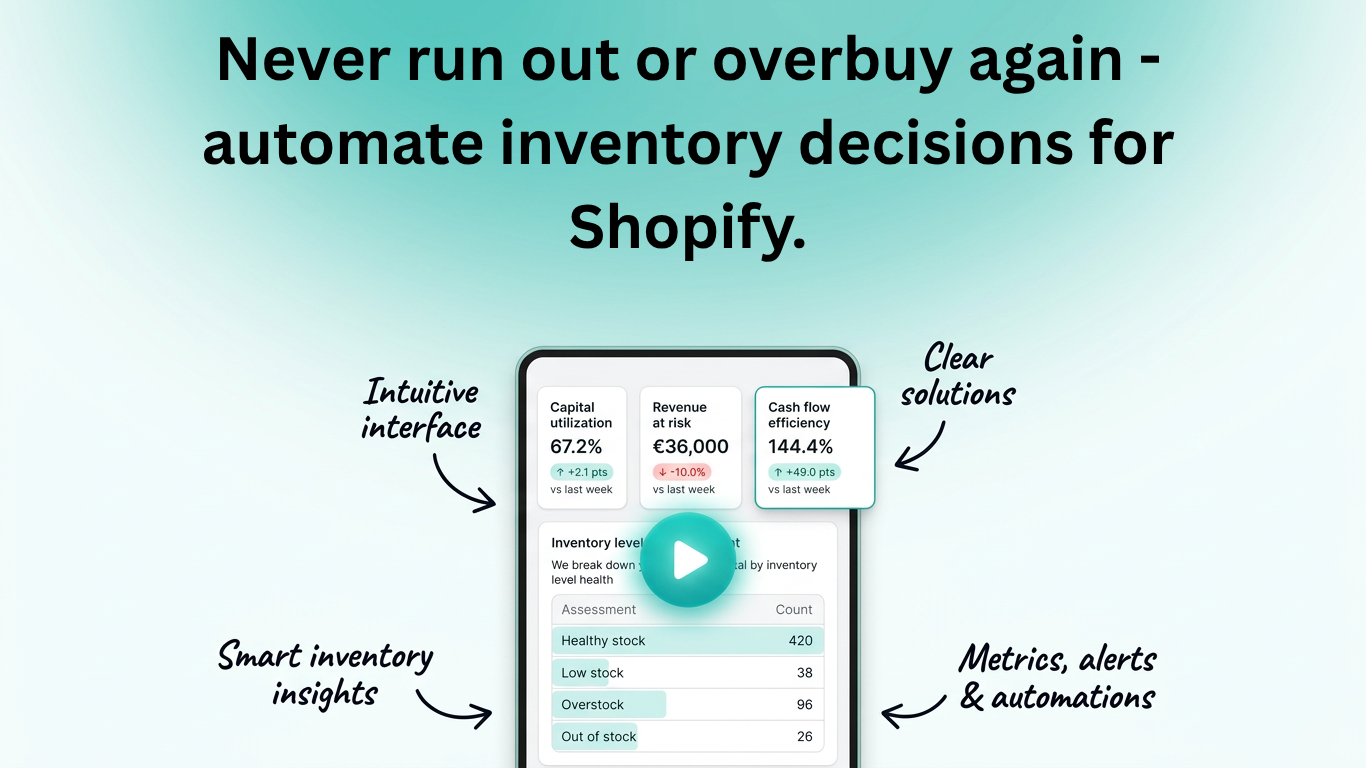
What Smart Replenishment helps you do
As a Shopify catalog grows, replenishment decisions become harder to manage in spreadsheets or static reports. Teams need to understand what is running low, what is likely to sell next, and which purchase decisions should be prioritized first.
Smart Replenishment in Synplex is built to turn that inventory complexity into an actionable workflow. Instead of manually checking every SKU, merchants get a more structured way to review demand signals, lead times, stock coverage, and next reorder actions.
What this page covers
- Prioritize urgent reorders before they become stockouts
- Reduce over-ordering on slow-moving products
- Create a clearer replenishment workflow for Shopify operations teams
- Connect reorder decisions more closely to supplier timing and inventory risk
The problem
Why growing Shopify brands need a better replenishment workflow
Most teams do not struggle because they lack data. They struggle because inventory decisions are spread across spreadsheets, supplier emails, and disconnected reports. That usually leads to reactive ordering, stockouts, and cash tied up in the wrong products.
01
Manual reorder reviews do not scale
When teams review product demand manually, it becomes harder to prioritize the right SKUs at the right time. What works with a small catalog often breaks once reorder frequency, supplier coordination, and SKU count increase.
02
Stockouts and overstock come from the same workflow gap
Without a structured replenishment process, merchants often under-order their fastest movers while overcommitting on slower inventory. That creates both lost revenue and unnecessary cash pressure.
03
Supplier timing changes what needs to be ordered now
A product may look healthy today, but long supplier lead times can turn a stable SKU into a future stock risk. Reordering decisions need to reflect timing, not just current quantity on hand.
Why Shopify brands use Smart Replenishment
Strong inventory operations are not only about visibility. Teams need clearer prioritization, faster purchasing workflows, and better control over stock risk.
Prevent stockouts earlier
Identify upcoming stock risk before a bestseller actually runs out, so the team can reorder with more time and less operational stress.
Protect working capital
Buy more deliberately by focusing purchasing attention on products that truly need replenishment instead of spreading spend across the whole catalog.
Create a repeatable process
Give operators a clearer daily workflow so replenishment decisions become more consistent across the team.
Reduce spreadsheet dependency
Bring reorder analysis into a system designed for Shopify inventory operations instead of patching together manual calculations.
Where Smart Replenishment is most useful
This feature is especially valuable when a team is moving from simple inventory visibility toward a more operational replenishment system.
Fast-growing SKU catalogs
As product and variant count grows, merchants need a way to identify which SKUs deserve purchasing attention first instead of reviewing everything manually.
Teams managing multiple suppliers
Supplier timing, reorder cadence, and operational coordination become more important once purchasing complexity increases across vendors.
Brands preparing for seasonal demand
Replenishment planning becomes more sensitive when promotions, launches, or seasonal peaks create larger forecasting and stock-coverage swings.
How Smart Replenishment fits into inventory operations
A strong replenishment feature is not just a dashboard. It should help a merchant connect product movement, inventory coverage, and purchasing actions inside one operational loop.
Prioritize what actually needs attention
Instead of reviewing every SKU with equal effort, teams can focus on products where stock risk, movement, and reorder urgency matter most. That makes replenishment reviews faster and more practical.
- Review urgent items first
- Reduce noise from low-priority SKUs
- Create a more actionable daily workflow
Screenshot slot — Prioritize what actually needs attention
Use supplier timing in reorder decisions
Good replenishment is not only about current inventory levels. It also depends on how long it takes to receive new stock and how much buffer the business needs to hold during that gap.
- Support better timing awareness
- Reduce reactive emergency purchasing
- Align purchasing with operational lead time reality
Screenshot slot — Use supplier timing in reorder decisions
Connect analysis to execution
A useful inventory workflow should not stop at visibility. It should help the team move from insight to actual purchasing actions with less friction.
- Improve handoff from planning to ordering
- Reduce spreadsheet-based follow-up work
- Keep replenishment tied to operational execution
Screenshot slot — Connect analysis to execution
How Smart Replenishment works
The workflow below shows how Synplex helps turn inventory data into clearer next actions. This matters most for operators who need a process that feels reliable day after day.
Sync Shopify inventory and sales context
Synplex uses your Shopify product and inventory context as the operational base for replenishment planning.
Review demand and stock risk signals
The system helps surface where inventory pressure is building so teams can focus on the products that need attention most.
Turn recommendations into action
Operators can move from review to reordering faster, with a clearer sense of what should be purchased next and why.
Built for operational inventory work
Synplex is designed for teams that need more than a static inventory dashboard. The workflow is meant to support day-to-day replenishment execution in Shopify environments.
Focus
Shopify-first
Built around merchant inventory workflows rather than generic ERP complexity.
Use case
Daily reordering
Supports recurring purchasing and replenishment reviews.
Outcome
Faster action
Helps teams move from stock review to next decision with less manual effort.
Frequently asked questions about Smart Replenishment
Related resources
Feature
Purchase Order Management
Create, track, and receive purchase orders natively in Shopify. Synplex covers the full PO lifecycle: draft, confirm, shipment receiving, landed costs, and Shopify inventory sync.
Learn more →
Feature
Supplier Management
Manage suppliers, lead times, MOQs, pricing tiers, and supplier performance metrics in one place. Synplex connects supplier data directly to your Shopify replenishment workflow.
Learn more →
Feature
Demand Forecasting
Synplex builds per-variant, per-location demand forecasts from your Shopify order history. Get monthly demand plans that drive replenishment, reorder dates, and stock projections automatically.
Learn more →
Calculator
Inventory calculators
Reorder point, safety stock, and planning tools.
Explore →
Ready to make reordering more systematic?
Use Synplex to turn inventory visibility into clearer replenishment action for your Shopify store.