Shopify inventory feature
Know what you will sell before you need to reorder it
Synplex builds demand forecasts per variant, per location, from your Shopify order history. Those forecasts drive reorder dates, recommended quantities, and stock projections - automatically, every night.
Per variant, per location
Forecast granularity
13 months forward
Planning horizon
Monthly + nightly
Update frequency
What Demand Forecasting helps you do
Replenishment decisions are only as good as the demand assumptions behind them. When teams use average sales or gut feel to estimate future demand, they consistently under-order fast movers and over-order slow ones - creating stockouts and dead stock at the same time.
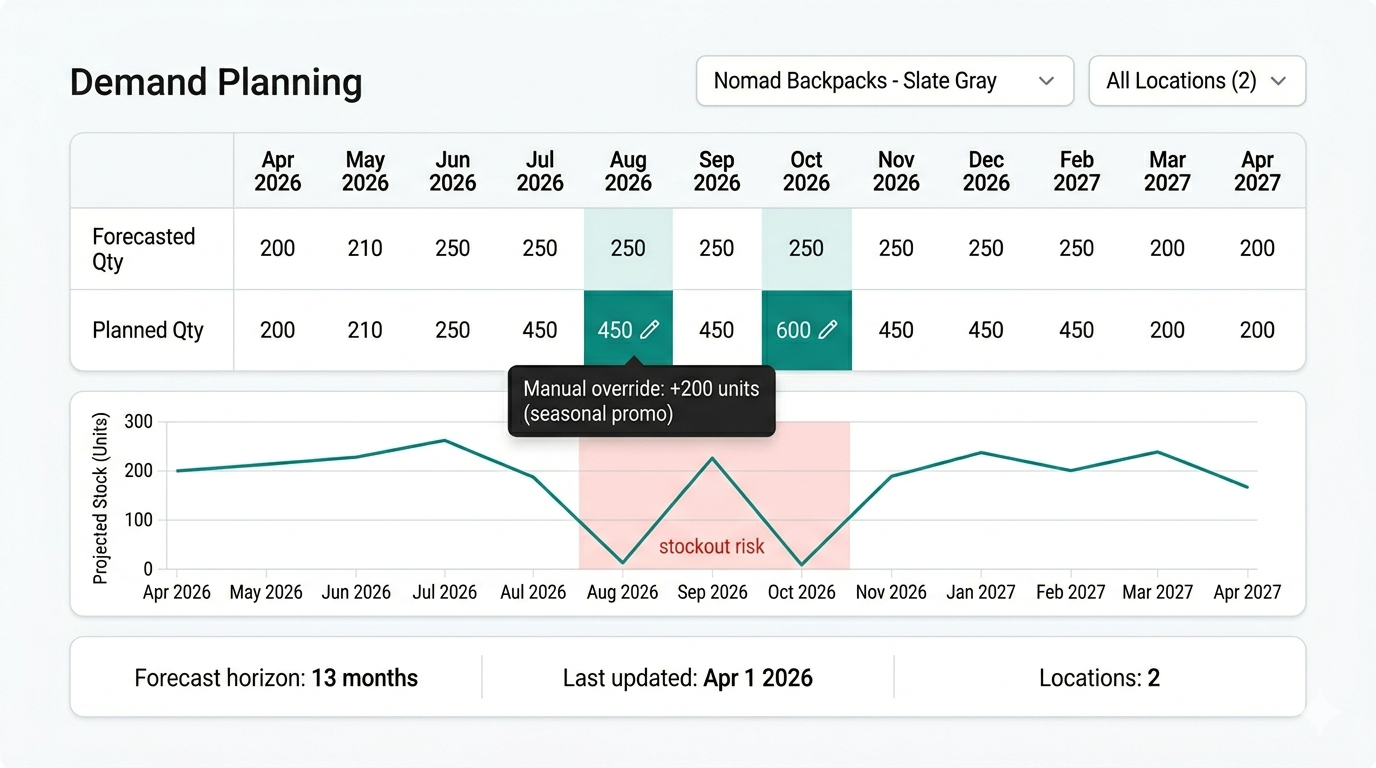
Synplex builds demand forecasts from your actual Shopify order history, at the variant and location level, updated monthly. Those forecasts become the single source of truth for every downstream calculation in the system - reorder dates, recommended quantities, stock coverage projections, and BOM component requirements all derive from the same demand plan.
What this page covers
- Forecasts built per variant and per location from Shopify order history
- Updated automatically every month - no manual refresh needed
- Override any forecast month manually while keeping the original forecast visible for comparison
- Downstream calculations - reorder dates, stock coverage, BOM components - all update automatically
- Demand plans cover 13 months forward from the current month
The problem
Why static sales averages produce the wrong replenishment decisions
Most inventory tools use simple sales averages to estimate demand. That works reasonably well for stable products but fails quickly when sales patterns are seasonal, trend-driven, or location-specific.
01
Averages smooth out the patterns that matter most
A 90-day average treats a seasonal spike the same as a slow period. For products with strong seasonal demand, that average consistently under-prepares the team for the high-demand months and over-stocks during the low ones.
02
Location-level demand is invisible in aggregate views
When demand is averaged across all locations, slower locations pull down the forecast for your busiest warehouse or store. Replenishment recommendations end up misaligned with where stock is actually needed.
03
Manual overrides have no audit trail
When a buyer adjusts a forecast in a spreadsheet, the original forecast is overwritten and the reasoning is lost. Next month, no one knows whether the current number reflects the system's prediction or someone's manual adjustment from three weeks ago.
Why Shopify brands use Demand Forecasting
Strong inventory operations are not only about visibility. Teams need clearer prioritization, faster purchasing workflows, and better control over stock risk.
Per-variant, per-location forecasts
Synplex generates a separate demand plan for every product variant at every location. A variant sold across three warehouses has three independent forecasts - so replenishment recommendations are always location-specific, not blended across the whole business.
Forecasts and overrides tracked separately
The forecasted quantity generated by Synplex is always visible alongside the planned quantity used in calculations. When a user overrides a month manually, the original forecast stays visible for comparison - so the team always knows what the system predicted versus what was decided.
Every downstream calculation updates automatically
Reorder dates, recommended order quantities, stock coverage dates, and BOM component demand all derive from demand plans. When a demand plan changes - whether from a monthly forecast update or a manual override - all downstream figures recalculate automatically.
13-month planning horizon
Demand plans are generated 13 months forward from the current month. That gives the team enough runway to plan purchasing for seasonal peaks, promotional periods, and new product launches without running out of forecast horizon.
Where Demand Forecasting is most valuable
Forecast-driven replenishment matters most when product demand is not flat - when seasonal peaks, trends, and location differences make simple averages unreliable.
Seasonal product catalogs
For brands with strong seasonal demand patterns, a forecast that accounts for historical seasonality produces far more accurate reorder recommendations than a rolling average during ramp-up and ramp-down periods.
Multi-location Shopify operations
When the same product is stocked at multiple warehouse locations or retail stores, per-location forecasts ensure each location gets replenishment recommendations based on its own demand - not an average across all locations.
Kits and bundles with component requirements
For brands using assembled products or BOM kits, parent product demand plans automatically drive component demand plans. When the planned quantity of a kit changes, all component requirements recalculate at the same location.
How the two planning systems work together
Synplex separates demand planning from supply planning but connects them tightly. Demand plans are the single source of truth - every supply-side calculation derives from them.
Demand planning: how many units will we sell?
Demand planning answers how many units are expected to sell per variant per location per month. Each month-level forecast is called a demand plan. It has two quantities: the forecasted quantity generated by the system and the planned quantity used in calculations. By default they are equal - a manual override changes the planned quantity while preserving the original forecast for reference.
- Forecasted quantity: generated by the engine, read-only
- Planned quantity: used in all calculations, editable via override
- Original forecast always visible alongside override for comparison
- Updated automatically on the 1st of each month
Screenshot slot — Demand planning: how many units will we sell?
Operational replenishment planning: what should we order now?
The operational replenishment pipeline runs every night for every active variant at every location. It uses current demand plans, confirmed inbound stock from POs and transfers, and supplier lead times to calculate reorder dates, recommended quantities, coverage dates, and stock assessments. No manual refresh is needed - figures are always current when the team opens the inventory table.
- Reorder date: when to place an order to avoid a stockout
- Recommended quantity: how much to order to reach target coverage
- Coverage date: when current stock plus inbound will run out
- Stock assessment: Healthy, Low Stock, Out of Stock, Overstock, or Dead Stock
Screenshot slot — Operational replenishment planning: what should we order now?
BOM and kit demand cascades automatically
For brands using assembled kits or bill-of-materials products, parent variant demand plans automatically drive component demand plans at the same location. When the planned quantity of a parent changes, component requirements recalculate immediately and cascade through to their replenishment metrics and supply plans.
- Parent demand plan drives component demand plans
- Cascades automatically on planned quantity change
- Component replenishment metrics update in the same run
Screenshot slot — BOM and kit demand cascades automatically
How Demand Forecasting works
The workflow below shows how Synplex helps turn inventory data into clearer next actions. This matters most for operators who need a process that feels reliable day after day.
Synplex imports your Shopify order history
On setup, Synplex pulls your historical order data from Shopify and uses it as the input for the forecasting engine. The more sales history available, the more reliable the initial forecasts.
Forecasting engine generates monthly demand plans
On the first of each month, Synplex regenerates demand plans for all active variants at all locations - covering 13 months forward. Forecasted quantities are read-only; planned quantities reflect any manual overrides the team has applied.
Downstream calculations update automatically
Every night, the operational replenishment pipeline recalculates reorder dates, recommended order quantities, stock coverage dates, and stock assessments for every active variant using the current demand plans as input.
Override any month when you have better information
When a promotion, product launch, or market change makes the system forecast unreliable, override any month manually. The original forecast stays visible, and all downstream calculations update to use the override immediately.
A forecasting system built for Shopify operations
Synplex forecasting is designed to give Shopify merchants a reliable demand foundation without requiring a data science team or a manual monthly planning process.
Forecast granularity
Per variant, per location
Independent demand plans for every SKU at every warehouse or store location.
Planning horizon
13 months forward
Enough runway for seasonal planning, promotions, and new product launches.
Update frequency
Monthly + nightly
Demand plans regenerate monthly; replenishment metrics recalculate every night.
Frequently asked questions about Demand Forecasting
Related resources
Feature
Smart Replenishment
Automate your Shopify reordering. Synplex helps brands calculate what to reorder, when to reorder it, and how to plan around lead times and stock risk.
Learn more →
Feature
Purchase Order Management
Create, track, and receive purchase orders natively in Shopify. Synplex covers the full PO lifecycle: draft, confirm, shipment receiving, landed costs, and Shopify inventory sync.
Learn more →
Feature
Inventory Reporting
Six pre-built inventory reports for Shopify: stockout risk, out of stock, dead stock, sales velocity, PO overview, and inventory health. Schedule automated reports and get emailed snapshots on your timeline.
Learn more →
Calculator
Inventory calculators
Reorder point, safety stock, and planning tools.
Explore →
Ready to replace sales averages with real demand forecasts?
Synplex builds per-variant, per-location demand plans from your Shopify order history and uses them to drive every replenishment decision automatically.